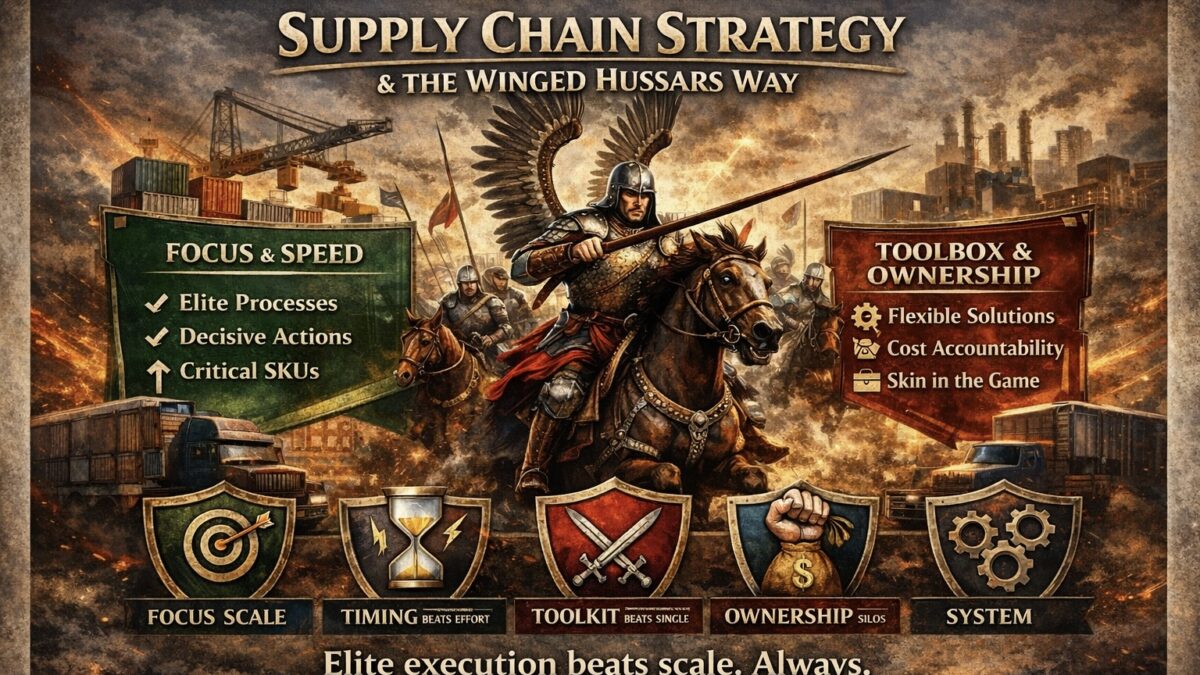
In the age of dashboards, AI forecasting, and global supply networks, it may seem counterintuitive to look for inspiration in a 17th-century cavalry unit. Yet the Polish Hussars — one of the most effective military formations in European history — offer surprisingly relevant lessons for Supply Chain Management (SCM) and Operational Excellence (OPEx) today.
This is not about nostalgia or romantic history. It’s about execution under uncertainty, focus on decisive value, and system-level thinking.
1. Elite Capability Beats Mass Resources
(Focus beats scale)
The Hussars repeatedly defeated opponents that were two to five times larger. Their advantage was not numbers, but:
-
superior training,
-
standardized equipment,
-
disciplined execution,
-
clear tactical purpose.
SCM parallel:
Organizations often try to compensate for poor planning with:
-
excess inventory,
-
oversized teams,
-
duplicated buffers.
True supply chain excellence comes from capability density, not volume:
-
fewer SKUs, better controlled,
-
fewer planners, better trained,
-
fewer KPIs, better aligned.
OPEx lesson: Don’t scale chaos. Build elite processes first.
2. The Decisive Strike Mindset
(Speed at the critical moment)
Hussars were not used everywhere, all the time. They were deployed only when conditions were right — terrain, timing, enemy fatigue. Their role was to break the system, not to fight endlessly.
SCM parallel:
Best-in-class organizations know:
-
not every issue deserves escalation,
-
not every week requires re-planning,
-
not every disruption needs a full firefight.
Instead, they focus on:
-
critical constraints,
-
high-impact SKUs,
-
moments where fast, decisive action changes outcomes.
OPEx lesson: Excellence is knowing when and where to act.
3. Toolboxes, Not Single Weapons
(Resilience over dependency)
The famous hussar lance was powerful — but temporary. Once broken, the hussar seamlessly transitioned to:
-
sabre,
-
thrusting sword,
-
firearm.
SCM parallel:
Overreliance on a single solution is dangerous:
-
one forecasting model,
-
one ERP report,
-
one supplier,
-
one planning philosophy.
Operationally mature organizations build planning toolkits:
-
statistical + judgmental forecasting,
-
push + pull logic,
-
buffers + agility,
-
automation + human override.
OPEx lesson: Resilience comes from options, not perfection.
4. Cost Ownership and Accountability
(Skin in the game)
Hussars financed their own horses, armor, and equipment. This created:
-
strong ownership,
-
respect for assets,
-
accountability for readiness.
SCM parallel:
When inventory, expediting, and inefficiencies are treated as “free”:
-
waste grows,
-
responsibility diffuses,
-
performance erodes.
Leading organizations make costs visible and owned:
-
inventory turns are personal,
-
service failures are traced end-to-end,
-
decisions have clear economic consequences.
OPEx lesson: Ownership drives discipline.
5. Why the Hussars Eventually Disappeared
(A warning, not a failure)
The Hussars did not vanish because they were ineffective. They declined because:
-
the system around them failed,
-
funding collapsed,
-
organizational reform lagged behind reality.
SCM parallel:
Even the best operations fail if:
-
governance is weak,
-
decision rights are unclear,
-
strategy and execution drift apart.
OPEx lesson: Operational excellence dies from neglect, not competition.
Final Thought
The Polish Hussars were not mythical warriors. They were a highly optimized operating system — designed for impact, clarity, and execution under pressure.
Modern supply chains face different enemies: volatility, complexity, fragmentation.
But the principles remain the same:
-
Focus beats scale
-
Timing beats effort
-
Toolkits beat silver bullets
-
Ownership beats compliance
-
Systems beat heroes
In SCM and OPEx, as on the battlefield, excellence is never accidental.