

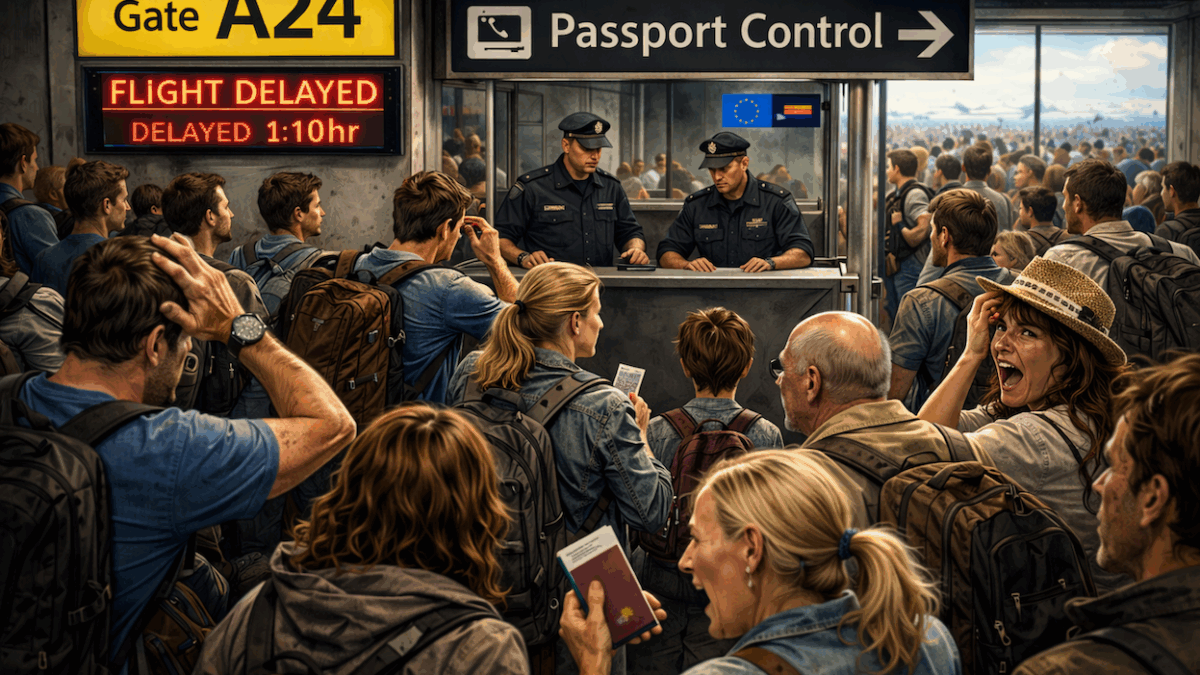
A short story of how customer value disappears
It starts calmly.
You arrive at the airport on time.
Security is slow, but manageable.
The departure board shows your gate.
Then things begin to unravel.
The gate changes — quietly, without a clear announcement.
Passengers start moving not because they understand the process, but because others are moving.
At the new gate, boarding doesn’t start.
Instead, passport control suddenly appears at the boarding gate itself — long after most passengers believed the process was complete.
Queues form instantly.
Families with children mix with non-Schengen passengers.
There is no structure, no priority, no clarity.
Minutes turn into an hour.
Then more.
The flight is delayed — not due to weather or aircraft issues, but because upstream processes have collapsed and the gate is now absorbing the failure.
At that point, frustration is no longer emotional.
It is rational.
“You are doing everything to make sure people don’t return”
During one of these moments, I had a brief exchange with a border control officer.
I made it clear — this was nothing personal.
But I also said something that captured the situation precisely:
“As an airport team, you are doing everything operationally possible to make sure passengers do not want to return to Lanzarote.”
Not because of attitude.
Not because of effort.
But because the system forces customers to absorb chaos, uncertainty, and delay.
That is the moment when this stops being a customer experience issue.
This is an operational design problem.
What actually went wrong (operationally)
From an operational perspective, several failures converge:
-
gates are reassigned reactively
-
passport control is pushed downstream to the gate
-
queues become unplanned buffers
-
boarding absorbs upstream breakdowns
These are not root causes.
They are symptoms of unmanaged flow.
Passengers become:
-
buffers for capacity mismatch
-
shock absorbers for poor planning
-
flexible inventory when the system breaks
That may keep operations moving — but it destroys customer value.
Translating the story into Lean & OpEx reality
Removing emotion and applying a Lean / Operational Excellence lens, four structural issues stand out.
1. Flow is unmanaged
Passengers move in undefined batches with no segmentation or pacing.
Lean violation:
Uncontrolled WIP creates instability and bottlenecks.
2. Capacity reacts instead of anticipating
Flight waves and passenger volumes are known, yet staffing reacts only after queues form.
Lean violation:
Capacity must follow takt, not queues.
3. The bottleneck is placed at the worst possible point
Passport control is performed at the boarding gate.
This single decision breaks the entire system.
Simple takt time example (data-driven)
Assumptions (realistic narrow-body flight):
-
passengers: ~180
-
boarding window: 30 minutes
-
required boarding takt: 10 seconds per passenger
-
measured passport check cycle time: ~15 seconds per passenger
-
officers at gate: typically 1
The math is brutal:
-
required takt < actual cycle time
➡️ boarding on time is physically impossible
What happens next is predictable:
-
queues build instantly
-
boarding stops and restarts
-
delays propagate to aircraft rotation
The gate becomes a damage-control zone, not a flow point.
Data-driven alternative: centralised passport control
Using the same cycle time data but relocating the process:
-
one shared non-Schengen passport control zone
-
serving multiple gates (e.g. 4–6)
-
4 parallel desks
-
same 15-second cycle time
Capacity outcome:
-
~16 passengers per minute
-
entire flight cleared in ~11 minutes
-
all passengers pre-cleared before boarding
Operational result:
-
boarding becomes pure flow
-
gate takt is protected
-
delays caused by passport control disappear
Lean principle applied:
Never place the constraint at the last step of the value stream.
4. No end-to-end ownership
Security optimises security.
Border control optimises border control.
Gate operations optimise gates.
No one owns passenger throughput end-to-end.
Lean violation:
Local efficiency creates global failure.
What would actually fix this (practical, data-driven guidelines)
These changes do not require new terminals or major CAPEX.
They require data, design, and discipline.
1. Fixed passenger flow segmentation
-
permanent Schengen / non-Schengen separation
-
dedicated family lanes
-
zero merging near gates
Driven by: passenger mix and processing time data.
2. Takt-based capacity planning
-
convert flight schedules into hourly arrival curves
-
staff security and passport control to takt
-
predefined escalation triggers before queues build
Driven by: arrival rate and cycle time analysis.
3. Protect the bottleneck upstream
-
passport control completed before gate allocation
-
gates used only for boarding
Driven by: throughput and constraint analysis.
4. One end-to-end flow owner
Single accountability for:
terminal entry → security → passport control → gate readiness
Driven by: value-stream ownership, not org charts.
5. Data-driven visual control (not crowd control)
-
visible queue separation by stream
-
screens showing real-time waiting times
-
visual thresholds linked to escalation rules
Passengers stop guessing.
Staff stop firefighting.
Driven by: queue length, waiting time, and compliance data.
Final thought
The ideas above are not prescriptions.
They are directional hypotheses based on observed behaviour, basic takt logic, and Lean / OpEx principles.
Any real implementation must be:
-
validated through Lean Six Sigma methodology (DMAIC)
-
supported by data analysis, not opinion
-
tested via cost–benefit analysis
-
evaluated against customer value, operational risk, and service reliability
Because Operational Excellence is not about proving how bad things are —
it is about designing better systems, based on evidence.
And when demand is predictable, chaos is not fate.
It is a design choice.


